Loïe Fuller
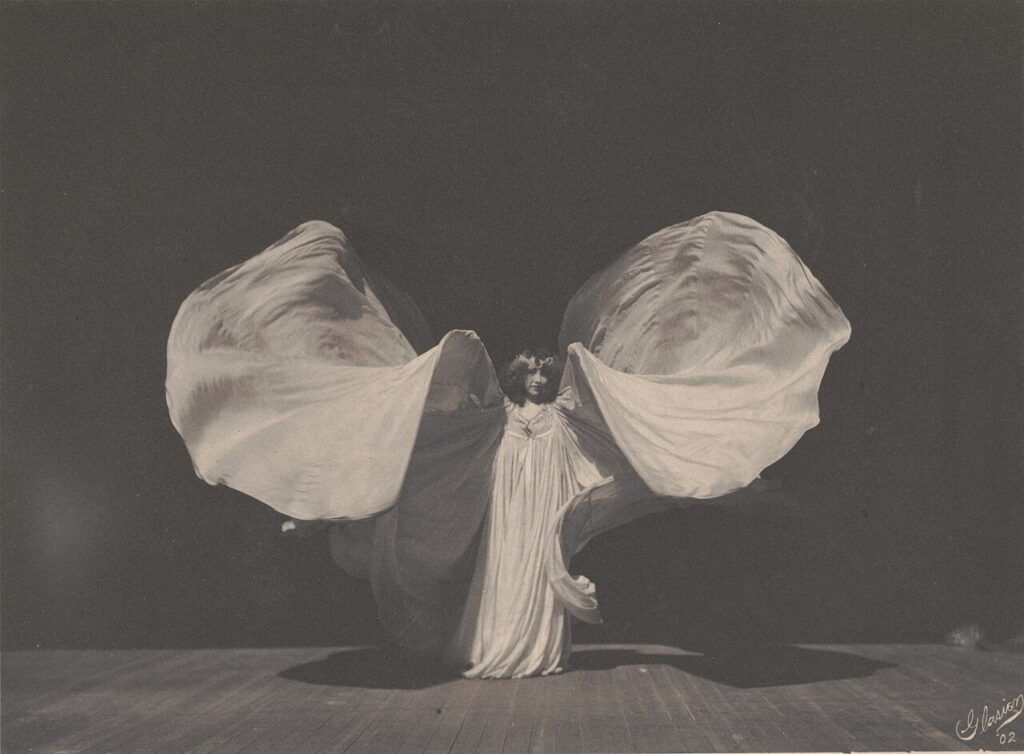
Loïe Fuller described theatrical illusion as something that could be built. Her United States patent of January 1894 specifies glass flooring, concealed illumination, and reflective supports intended to make a dancer appear suspended in space. The document joins an artistic effect to an apparatus. Fuller claimed authorship through the language of invention as well as through her body onstage. The patent’s actual printed name is Marie Louise Fuller; a defective digital heading should not be turned into an alternative identity.
Born in Illinois in 1862, Fuller worked in popular theater before making her name in Paris. NYPL records her arrival in 1892 and her success at the Folies Bergère. Flowing fabric and changing light helped produce a dance whose visible form could exceed the outlines of the performer. She participated in the making of modern performance through technical experimentation, choreography, and decisions about what audiences would be able to see.
The 1894 patent makes some of that labor unusually concrete. Light projected from below would illuminate a garment while dark scenery and reflective surfaces concealed its support. The drawings and specifications can be compared with actual stage conditions, without assuming that an invention was used exactly as proposed at every performance. Patenting an effect and mounting a production are different activities. Both belong to the history of her work.
Fuller’s long partnership with Gabrielle Bloch, known as Gab Sorère, was romantic and professional, according to NYPL. Bloch contributed stage design and mechanical effects, and the women collaborated in filmmaking. Their shared work should be credited specifically. Sorère’s independent role continued after Fuller’s death, when she managed the company. The intimacy of their life cannot be reconstructed solely from the surviving business correspondence, but it need not be erased because that correspondence chiefly concerns work.
Fuller’s ambitions also extended to institutions and collections. Maryhill Museum credits her with persuading Samuel Hill to convert his unfinished mansion into an art museum. Its Rodin collection account records that she brokered sculpture sales to American collectors and used works of her own as collateral for a loan she could not repay. Hill discharged the debt; those works entered the museum through his bequest. Cultural influence here involved persuasion, transactions, and financial vulnerability, not only admiration between artists. [3,4]
Her friendship with Queen Marie of Romania and her artistic connections formed part of that organizing world. A recent documentary’s producers identify both her dance school and her experimentation with Sorère as central to the career. Its description also places her in relation to the younger Isadora Duncan. These accounts suggest a productive comparison of different forms of dance authority, while rivalry and private motives require more exact evidence than a promotional synopsis supplies.
Fuller’s connection to Natalie Clifford Barney is indirect in the evidence assembled here. Sorère’s reported attachment to Damia links the branch to Eileen Gray and the design network around Wyld and de Lanux. Fuller’s cultural world also overlaps with people already retained in the Constellation. No Fuller–Barney affair is claimed. Her biography matters independently because she made artistic effects into intellectual property, carried influence into museums, and sustained a working partnership between women whose individual contributions remain open to recovery. [1–5]
+ Add a connection or correction ↗
Connections in the archive
Open the institutional or reference source ↗
Explore the sources above to distinguish historical records from the novelist’s fictional interpretation.