NATALIE’S CONSTELLATION / THE IDEAS BEHIND IT
From Sappho
to The Chart.
A poet whose work survives in fragments. A small temple in a Paris garden. A fictional chart on television. Each suggested a different way to think about the connections between women’s lives.
Enter Natalie's Constellation ↗01 / AN ANCIENT VOICE
A voice that kept being heard.
Sappho’s surviving poetry gave later writers, including Natalie Clifford Barney and Renée Vivien, language and imaginative possibilities. Their engagement with her work belongs to their own time, not to a single recoverable ancient tradition.
Natalie and Renée Vivien approached Sappho through poetry and translation. Their interpretations were modern literary work, not a reconstruction of an ancient community.
Explore Sappho’s influence ↗Research: Rebekkah Dilts, “(Un)veiling Sappho” (2019) and the Library of Congress research guide.
02 / THE GARDEN AT RUE JACOB
The garden at rue Jacob.
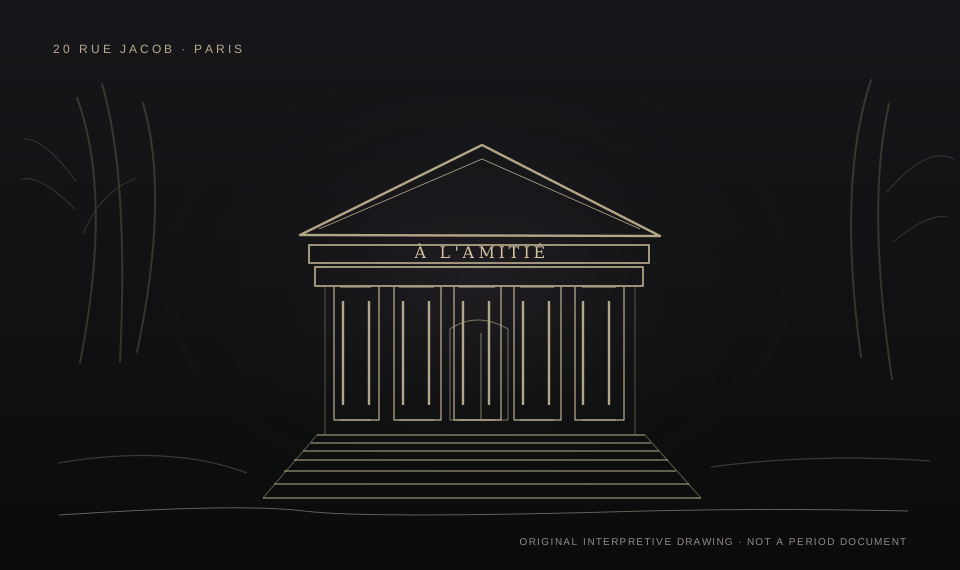
Natalie’s Paris garden and Temple of Friendship became part of the setting of her social world. A published 1929 salon diagram offers one historical representation of that network. The modern Constellation is a separate interpretation.
A foldout chart in Natalie’s 1929 Aventures de l’esprit maps names associated with her salon from the years around 1910 to 1929. Its line toward the Temple has become an enduring image of her social world. Scholarly treatments differ in how they describe the hand behind the drawing; attribution should follow direct examination of the original edition.
03 / A DIFFERENT CENTURY’S CHART
A chart in another century.
In Showtime’s television series The L Word, the character Alice Pieszecki, played by Leisha Hailey, maps romantic and sexual connections within a community of women. The fictional device is known as The Chart. That device helped inspire the navigational idea here. Natalie’s Constellation instead follows historically sourced connections of several kinds.
Natalie’s Constellation acknowledges that modern visual idea while giving it a different purpose: tracing documented historical connections through family, love, intellectual influence, artistic collaboration and surviving evidence.
It is an independent work of historical interpretation. It does not reproduce the show’s chart, graphics or stills, and neither Leisha Hailey nor the series’ creators are associated with the project.
Sources: Showtime press release identifying Leisha Hailey as Alice; episode-linked summary of The Chart. This page is not affiliated with, authorized by or endorsed by Showtime, Paramount, The L Word, or Leisha Hailey.
04 / HOW TO READ TWO VERY DIFFERENT CHARTS
Where the lines lead.
In The L Word, Alice Pieszecki’s Chart turns connections into a visible map. It is a storytelling device: relationships, breakups and unexpected intersections become part of an expanding social web. The television chart tracks the fictional world of its characters, not documented historical events.
Natalie Clifford Barney’s real circle is a different inquiry. A relationship in the Constellation may be familial, romantic, literary, artistic or social. Each line requires a source and a careful distinction between primary evidence, institutional records, published accounts and unresolved research leads.
Start with the interactive Constellation, search a name in the historical biographies, or examine how sources and evidence weights are handled. Researchers may submit a documented connection for private review.
The two charts share a way of visualizing relationships. They do not share a documented historical origin, authorship, or affiliation.