Alla Nazimova
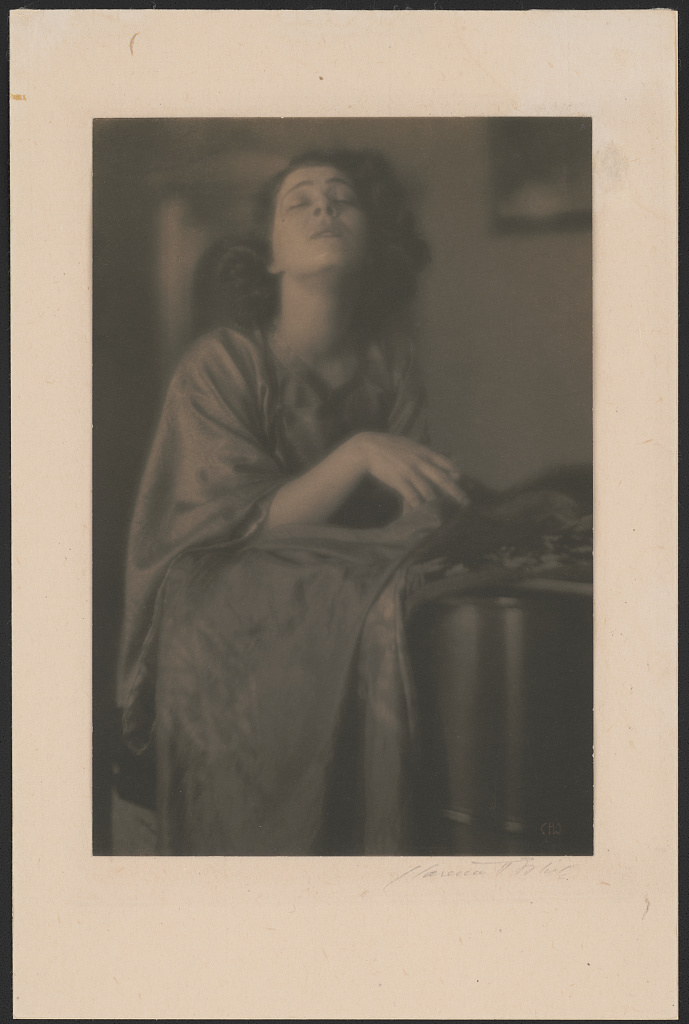
Alla Nazimova’s career crossed the distance between interpreting a part and controlling a production. The Library of Congress records her English-language debut in Hedda Gabler in 1906, her first film in 1916, and her subsequent work as a producer. Gavin Lambert’s biographer-publisher describes an actress who established her own company and sought artistic control. These achievements deserve to lead her history, rather than the much-repeated stories about Hollywood parties. [1,2]
Born in Yalta in 1879, Nazimova trained in Moscow and worked with Konstantin Stanislavsky before arriving on the American stage with Paul Orleneff’s company. Her birth name and exact date appear differently in available accounts and need verification. What is clear in the professional chronology is a substantial movement between languages and theatrical systems. Performing Ibsen in English became an important part of an American career built by an immigrant actress.
Film offered money and another medium for ambition. She signed with Metro Pictures in 1918 and produced and acted in Camille. Her adaptation of Oscar Wilde’s Salomé brought the design world associated with Aubrey Beardsley’s illustrations into silent cinema. The Academy Museum identifies her as producer and star, while institutional records vary in their treatment of direction and the film’s 1922 production and 1923 release dates. Exact credits should be examined before her contribution is either minimized or enlarged. [1,3]
The Library of America’s account describes the financial failure of Salomé and the heavy losses associated with turning her property into the Garden of Alla Hotel. These ventures help explain why financial resources and artistic authority did not guarantee lasting security. Her later return to the stage, including A Month in the Country and Mourning Becomes Electra, belongs to the same career. Commercial difficulty did not end her capacity to perform or make influential work. The precise sums and transactions still require the underlying contracts and accounts.
Her relationship with Charles Bryant also requires precise language. The Library of Congress describes a couple who publicly presented themselves as married but never married. Its finding aid identifies letters to Nazimova’s sister Nina Lewton that discuss their relationship as well as touring and household matters. A public marital identity and a legal marriage are different facts. Nazimova’s attachments to women, meanwhile, require their own sources rather than assumptions drawn from that arrangement.
Dolly Wilde supplies a specific intimate route to Natalie Clifford Barney. The Library of America, drawing on Lambert’s biography, explicitly identifies an affair between Nazimova and Dolly during a visit to France. EPIC also reports it. The Library of America further identifies an attachment to the artist Maurice Sterne, shared at different times with Djuna Barnes. Each relationship remains individually keyed in the archive, with original private evidence still to be inspected. Barnes’s interview with Nazimova is journalism, not proof of a romance between the two women. [4,5]
Nazimova expands the Constellation into theater and early filmmaking, where women could command salaries, finance experiments, and lose control of money or reputation. Her independent legacy includes performance, production, and the ambition to shape an entire work. Her lovers connect her to Natalie’s world, but they do not supply all its significance. Family correspondence, films, and stage records can recover the labor behind an image that Hollywood history has often reduced to glamour. [1–4]
+ Add a connection or correction ↗
Connections in the archive
Explore the sources above to distinguish historical records from the novelist’s fictional interpretation.