Georgette Leblanc
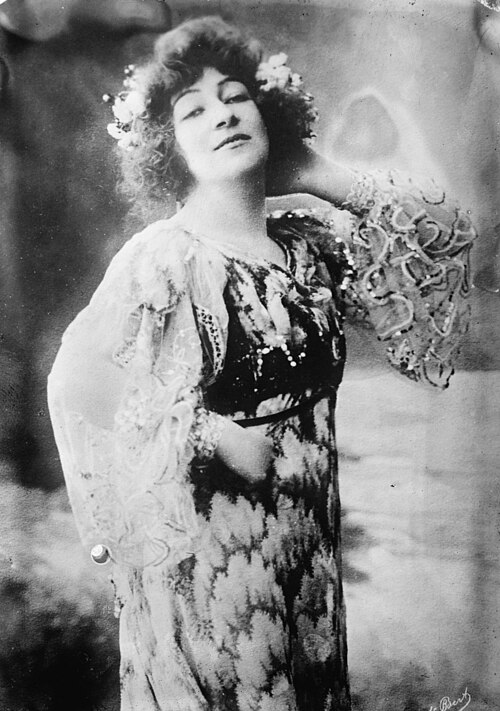
Georgette Leblanc’s career crossed the boundary between singing a role and creating its dramatic presence. She entered the Opéra-Comique company in 1893 and became a notable interpreter of Carmen in Paris and Brussels. The theater’s historical account identifies her participation in the inauguration of the third Salle Favart in 1898. Her place in that professional institution preceded the avant-garde film for which she is now often remembered. [1,2]
She was the sister of the novelist Maurice Leblanc and the companion of Maurice Maeterlinck. Their relationship was also artistic. Yet Maeterlinck’s association with Pelléas et Mélisande did not secure her the role of Mélisande: Debussy refused her for the creation. She did create Ariane in Paul Dukas’s Ariane et Barbe-Bleue in 1907. Contemporary assessments distinguished admiration for her acting from reservations about the volume of her voice. These judgments should remain attributed, rather than becoming a biographer’s unexplained verdict on her talent.
Her work as an author extended a stage text into another medium. The Children’s Blue Bird, published in English in 1913, adapted Maeterlinck’s play as a story for children. A subsequent school edition credited her, the translator Alexander Teixeira de Mattos, and the educational editor Frederick Orville Perkins. The opening differentiates the children’s characters and places their poverty beside a neighboring wealthy household. This was an adaptation with a new narrative voice and readership, not merely Maeterlinck’s title carried into another format.
In L’Inhumaine, released in 1924, Leblanc played the singer Claire Lescot. Her contribution also involved financing and American distribution. Monica Nolan’s San Francisco Silent Film Festival essay describes an agreement under which she provided half the funding and took responsibility for that market. Nolan challenges accounts that reduce the production to an ambitious male director obstructed by a powerful, aging female star. The finances gave Leblanc an active role in bringing the film into existence, although the contracts and full production history still require examination.
The film joined performance with modern design. Its collaborators included Fernand Léger, Paul Poiret, Robert Mallet-Stevens, and Darius Milhaud. The Opéra-Comique’s discussion treats Leblanc’s restrained screen acting as a significant adaptation of theatrical experience to the camera. Watching the restored film and comparing it with contemporary reviews would permit a closer assessment than simply repeating the hostile descriptions that entered later criticism.
Her later life was shared with Margaret Anderson. The Yale collection biography identifies their romantic partnership, and the papers preserve Leblanc’s writings and drawings as well as translations made by Anderson and Solita Solano. The record joins intimate support to literary work without requiring an invented account of the household’s private conversations.
Leblanc belongs to Natalie’s wider erotic and artistic circle in Artemis Leontis’s account, but the selected passage does not settle a particular Leblanc–Barney pairing. Her connection must remain qualified. She illuminates the Constellation through artistic authority exercised across opera, books, film, and women’s partnerships. Her independent work requires recovery alongside the better-known men and women with whom she lived and collaborated. [1,4,5,6]
+ Add a connection or correction ↗
Connections in the archive
Open the institutional or reference source ↗
Explore the sources above to distinguish historical records from the novelist’s fictional interpretation.